German Army
The Glass RoomThe German Army appears as both an advancing military force and the authority that makes borders, uniforms, and identity papers decisive in ordinary life. Its arrival helps dismantle Czechoslovakia, brings Nazi rule within reach of the Landauer family, and culminates in a checkpoint where Katalin and Marika are detained despite possessing travel documents. The novel’s account stresses that the power to classify and stop people does not rest on paperwork alone: it also rests on armed officials’ discretion.
Advance and political dismemberment
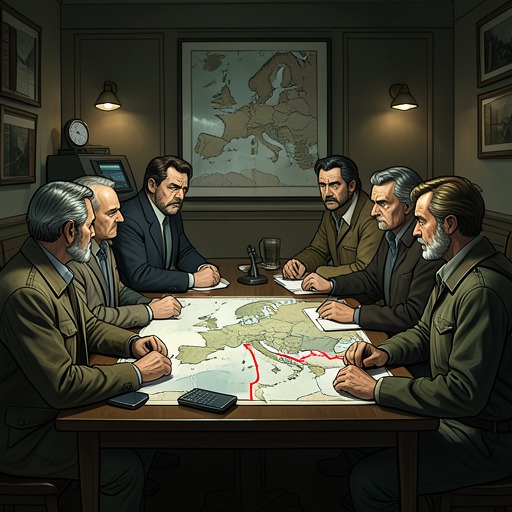
In the aftermath of the Munich crisis, the German Army enters Czechoslovak territory as the country’s political structure is being carved apart. The narration describes German troops in field-grey uniforms marching into towns including Eger, Karlsbad, Teplitz, and Liberec while the Czechoslovak army stands down. Poland and Hungary also take territory, and refugees flee along roads and across fields with handcarts and bundles. The passage likens the country’s partition to the dismemberment of a body, framing the army’s advance as part of a wider collapse rather than an isolated military movement.
The photographs of troops crossing the border make that advance an image interpreted differently on either side: German papers describe a peasant woman’s tears as joy, while Czech papers read them as despair. The contrast exposes how the same occupation can be presented as welcome or catastrophe, even as people are already fleeing its consequences.
Occupation reaches the Landauer family
After the Anschluss, Viktor recognizes the danger to his Jewish family as more than a distant German policy. He tells Liesel that Nazi rule has reached Austria and that the border territories between them and the Nazis are already German. He does not want his family to flee in panic or leave with only what they can seize at the last moment; instead, he has begun moving funds and proposes Switzerland as their destination. The new political geography turns escape from a contingency into a plan.
When the family later travels through the city, military vehicles block access to the railway station near the Grand Hotel. German soldiers stop cars, and the unfamiliar Feldgendarmerie uniform becomes a visible sign that the occupation has arrived. Liesel holds Viktor’s hand for reassurance while the children watch the soldiers with uncomprehending curiosity. The encounter marks the shift from political warning to direct control of movement.
Checkpoints, papers, and detention
At the station, the family’s route depends on inspection of passports, visas, and tickets. A Feldgendarmerie official demands their documents and scrutinizes the papers, while other passengers are taken away over problems of identity and authorization. The documents initially appear to offer a route onward, but the scene makes clear that possessing them does not secure passage.
Katalin has a refugee passport, a Nansen passport, and visas for the journey. When she presents her papers, an official prevents Viktor from speaking for her and calls over another official to examine them. Katalin is then led to a nearby hut, and Marika is taken to join her. Liesel draws the frightened child close and says that she is with the family and will be looked after; Viktor protests that Katalin’s papers are in order and valid for travel through France and Spain.
The official warns Viktor to return to the train or risk detention. The family is pushed back toward the carriage, and Katalin’s and Marika’s suitcases are taken away. The narrative leaves the immediate outcome uncertain: the official suggests the delay may be temporary, but offers no assurance. In this encounter, the German Army’s authority is shown not only in its armed presence but in the power to separate a mother and child from their companions, suspend their journey, and make legal status subject to an official’s decision.
The house under occupation
The German occupation also changes the meaning of the Landauer House. Under Rainer von Abt’s design, the growing house and Ottilie’s development had once unfolded together: the child’s milestones contrasted with the slower construction of steel beams, concrete, and enclosed space. After the occupation, the house is transformed into a biometric research centre. Its upstairs rooms become offices, the kitchens are converted into a laboratory, and a basement room is prepared for an X-ray machine. Anthropometric equipment is installed beside the onyx wall, while the dining area becomes a photographic studio.
The house’s original furnishings are absorbed into the new institution. Its Bösendorfer piano remains, incongruous amid the measuring equipment and photographic apparatus; the German Hollerith machines and files occupy spaces formerly used for the Landauer family’s cars and domestic life. The contrast makes occupation legible as a remaking of space: the house that once embodied private modernist order is repurposed for bureaucratic measurement and racial classification. The German Army is not itself identified as the centre’s operator in this passage, but its advance and the political order it enforces make the conversion possible.
Narrative significance
Across these episodes, the German Army’s power is represented through a progression from invasion and territorial loss to the checkpoint’s immediate, personal consequences. The recurring border is not merely a line on a map: it determines who can travel, which documents count, and whether a family can remain together. The station scene gives that system its human scale, while the converted house shows occupation reaching beyond roads and public institutions into the architecture of private life.